Act Now–The Elevator Group $10 Book Sale Extended Through Labor Day

Last chance to buy Becoming Valley Forge for $10 in The Elevator Group’s summer sale. See post below and go to http://www.TheElevatorGroup.com.

Sheilah Vance's avatarSheilah Vance

Girl readingLast chance to stock up on your summer reading with The Elevator Group’s $10 per book Summer Book Sale, now extended through Labor Day, September 5!  Click here to purchase direct from The Elevator Group at http://www.TheElevatorGroup.com.

All of our award-winning and  best-selling books are now on sale through Labor Day, September 5, 2016.

Act now because prices go back up on September 6!

Enjoy and happy reading!

View original post

“The perfect beach read…”–Main Line Today Magazine

Catching up on a great review   for my novel Becoming Valley Forge in  July’s Main Line Today magazine.    “This exacting work of historical fiction from Paoli’s Sheilah Vance explores the lives of ordinary men and women—a former slave, a farmer, Army volunteers—as revolution engulfs the region. The perfect beach read for a patriotic month.”  Thank you Lisa Dukart!

Check out the novel on Amazon or for $10 direct from the summer book sale at The Elevator Group.

Happy beach reading!

Buy Becoming Valley Forge for $10 through September

Girl readingClick here to purchase Becoming Valley Forge for only $10 (about 40% off the $17.95 retail price) direct from The Elevator Group at www.TheElevatorGroup.com with The Elevator Group’s $10 Summer Book Sale from now through September 1.

Get this award-winning book and all of The Elevator Group’s   award-winning and best-selling books on sale through September 1, 2016.

Enjoy your summer and happy reading!

Leaving Valley Forge and on to independence

On June 19, 1778, The Continental Army left Valley Forge.

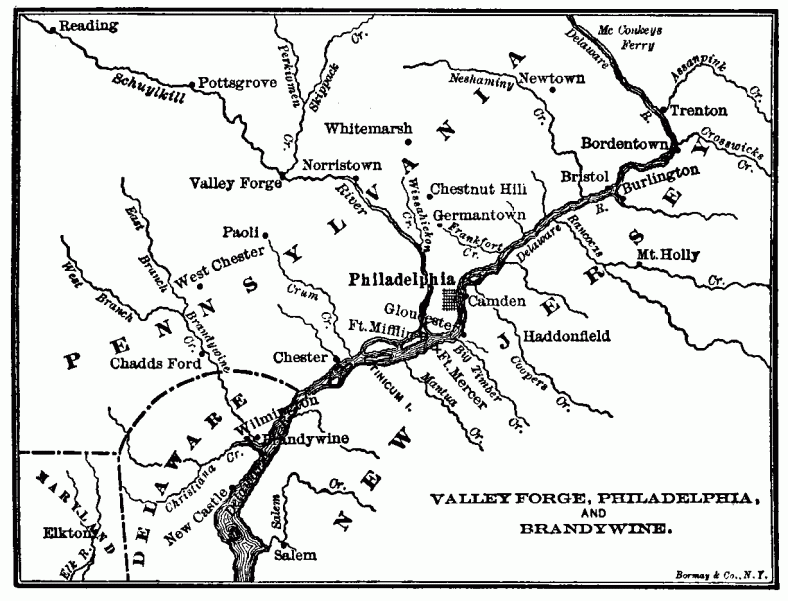
Map of Valley Forge and BrandywineThe army left Valley Forge more disciplined and as a better fighting force than when they marched in on December 19, 1777.  Unfortunately, some 2,000 died during the Valley Forge encampment.  Yet, the army persevered.

When the army left Valley Forge, they headed towards the British army, which left their winter quarters in Philadelphia towards New York.  The Continental Army caught up with the British army at Monmouth, New Jersey where they showed their new mettle as a better fighting force in the Battle of Monmouth..

Becoming Valley Forge 9780982494592The sacrifice of the Continental Army, George Washington and his generals, and all of those who supported them at Valley Forge is legendary.  It is one of the things that inspired me to write my novel, Becoming Valley Forge.  In walking through the Valley Forge Natioanl Park one day in 2010 with a friend, I was overcome with the feeling and the sacrifice of those six months.  As we walked for miles, we came across commemorative markers from various groups like the Sons and Daughters of the American Revolution, local historical societies and counties, and groups such as Delta Sigma Theta Sorority, with their Patriots of African Descent in the Revolutionary War monument.  We stopped at the striking statue of General Anthony Wayne, on whose land my home in Paoli is located, and when I returned home, I felt spirit of General Wayne and those who fought in and lived through the Paoli Massacre.

At every spot, honoring this regiment or that, I wondered–what was it like for the people in those regiments? What was it like for the people who lived here when those regiments descended on this area during the Philadelphia Campaign and its battles–Brandywine, Germantown, Paoli, Barren Hill–and its encampments, like Rebel Hill and Gulph Mills, where I grew up?  What happens when 11,000 soldiers come to your backyard?   What happens when you are in the midst of a war when you are just a farmer or a businesswoman just trying to make a living?  What happens when the British army descends on your town, bringing their repression straight to your front door, stealing your food, harming your family?

These were the questions that all made up the sum and substance of that fiction writer’s question–what if?  What if the war came to your backyard? What would that be like?  So, I tried to answer those questions in Becoming Valley Forge through the eyes of a family of patriot farmers, spies and soldiers from Paoli; a blacksmith, then soldier, patriot from Rebel Hill; a blacksmith, then soldier, former slave from Rebel Hill who purchased his freedom and sees the war as a means to an end to purchase his fiancée’s freedom from a nearby plantation; a brothel owner in Germantown who was disowned by her Paoli family and who services the chief commander of the British Army during their occupation of Philadelphia; the Oneida Indians who come to Valley Forge to assist their friend, General Washington; and others.

Becoming Valley Forge is my homage to the Revolutionary War and those who fought in and supported it.  I appreciate their sacrifices for our freedom.  And, as an African American woman, I had to keep it real and address the dichotomy of people who fought for the freedom of their country while so many African Americans who lived there were not free.  I wanted to honor the contributions of the Oneida Indians and all of the different types of people who “became Valley Forge”–not just the white male soldier who most of us learned about in history class.

I thank God for those with whom my novel has resonated with positive reviews from the  Midwest Book Review (read full review here, too) and the  Historical Novel Society and with winning the Regional Fiction category in the Next Generation Indie Book Awards.  And I thank all of my readers who took the time and spent the money to read this novel. I also thank the Museum of the American Revolution and the Cabin Shop at the Valley Forge Park Memorial Chapel for carrying my novel, so pick up a copy of you visit there this summer.

So, as the Continental Army moved out of Valley Forge and on to other things, I’m going to do the same.  I’ll blog here occassionally about Becoming Valley Forge, but I won’t blog regularly until we get closer to September 11–when, in 1777, the Continental Army began the Philadelphia Campaign with the Battle of Brandywine, and when Becoming Valley Forge begins.

If you read Becoming Valley Forge during the summer, I’d love to hear from you.  Please feel free to email me at svance@theelevatorgroup.com.

Peace.

Sheilah Vance

Leaving Valley Forge with independence in sight

Sheilah Vance's avatarSheilah Vance

About two weeks ago, I attended Heritage Night at the Valley Forge National Historic Park, sponsored by the Valley Forge Alliance.  This event commemorated the day the Continental Army left Valley Forge–June 19, 1778.

Map of Valley Forge and BrandywineThe army left Valley Forge more disciplined and as a better fighting force than when they marched in on December 19, 1777.  Unfortunately, some 2,000 died during the Valley Forge encampment.  Yet, the army persevered.

When the army left Valley Forge, they followed the British army, which had just left their winter quarters in Philadelphia and headed towards New York.  The Continental Army caught up with the British army at Monmouth, New Jersey where the patriots showed their new mettle as a better fighting force in the Battle of Monmouth..

The sacrifice of the Continental Army, George Washington and his generals, and all of those who supported them at Valley Forge is legendary.  It is one of…

View original post 636 more words

Join us for the Lower Merion Twp. Memorial Day Parade

Though initially proclaimed to honor those who died in the Civil War, and initially called Decoration Day, asking people to decorate the graves of those who died during the war, Memorial Day has become a day to honor all of those who died in the service of the United States of America.  The holiday honors the first patriots, like those in my novel Becoming Valley Forge, through today’s brave enlisted men and women.Today, Memorial Day is celebrated in parades all over the country honoring veterans and all things American.

Thanks to the kind invitation of Lower Merion Township Commissioner Steven Lindner, I’ll be riding in the Lower Merion Township Memorial Day Parade on Monday, May 30. 

The parade will begin at Greenfield Avenue at the firehouse at 10:30 a.m. and process to St. Paul’s Cemetery for the Memorial Day Service at 11:15 a.m. Michael T. O’Hagan, a veteran of the United States Marine Corps, is the guest speaker for the service.  At the end of the service, many participants will march to the Leon Spencer Reid American Legion Post 547 at Simpson Rd. and County Line Rd. for a drill team show and holiday celebration.

Elizabeth Fisher, author of Dining With the Dollar Diva, and I will be selling  our books  at our vending table at the Legion from around 1130 – 2.  Stop by and stock up on some summer reading!

Happy Holidays!

Battle of Barren Hill 5/20/1778: Rebel Hill, Oneida Indians, Gens. Washington and Lafayette

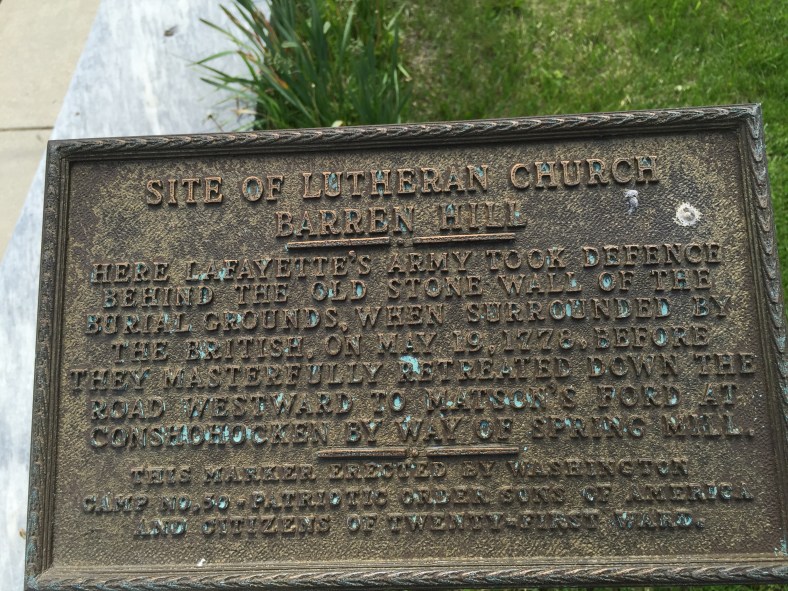
On this day in 1778, some 2000 soldiers, including some 50 Oneida Indians, engaged in the Battle of Barren Hill, on and around the grounds of St. Peter’s Lutheran Church in Lafayette Hill, Plymouth Whitemarsh, PA.  This battle is one of the climactic final chapters in my novel, Becoming Valley Forge, and a climactic event of and the only true battle fought during the Valley Forge encampment.

General George Washington commanded  Gen. Marquis de Lafayette to lead this group of 2000 soldiers and head towards Philadelphia to see whether the British were planning to evacuate Philadelphia or even attack the Continental Army at Valley Forge now that winter had ended and both armies would be leaving their winter quarters–the Continental Army’s being Valley Forge and the British’s being Philadelphia and what was then its suburb, Germantown.  Once the troops reached Barren Hill, about 500 soldiers, including some 50 Oneida Indians, were sent out as advance guard scouts, and actually engaged with the British.  Historians have noted that nine soldiers, including six Oneida Indians, were killed.  The bulk of the soldiers were able to retreat back across Matson’s Ford to modern day Rebel Hill.  However, while Lafayette and his troops were at Barren Hill, General Washington, concerned about what was or could be happening, had the rest of the Continental Army at Valley Forge of about 7-8000 soldiers,  on alert to join the battle, if needed.  Washington himself rode to Rebel Hill to see what was happening with his army and the man who he considered to be like a son–Gen. Lafayette.

One historian notes, “The older general [Washington] then rode south from Valley Forge to a point west of Matson’s Ford accompanied by most of his staff.  Units of the Continental [a]rmy began forming up on the slope above the ford.  There Washington watched apprehensively from the rocky heights as he saw the red coats advancing on the pride of his army, including his personal Life-Guard.  The British were about to kill or capture the men he had trained through the harsh and killing winter months.  Surrounded by his generals, he waved his hat and shouted encouragement amidst the cannon fire and smoke of his artillery that were covering the retreat (Lossing 1860, 261).”  See The Oneida Nation’s Contributions at Valley Forge by Greg Chester (2009).

The Oneida Indians played a pivotal role at the Battle of Barron Hill.  Some 50 Oneida Indians had just arrived at Valley Forge just a week earlier, on May 13, to assist the Continental Army.  As explained in an article on the Oneida Indian Nation website,

“Washington asked Lafayette to recruit Native allies in anticipation of a spring movement of the armies.  The Oneidas had long-standing ties of friendship with the French, and Lafayette’s presence seemed to make the possibility of French aid on the American side more likely. They adopted Lafayette and gave him the name of a warrior who had died 12 years earlier, Kayewla, during a meeting at Johnstown, N.Y. in early March 1778. As was the custom on such occasions, Lafayette accompanied his request for Oneida warriors with wampum belts, which testified to the truth and importance of his message, and some money for the Oneida people to buy the foreign goods they had come to depend upon.  In his own accounts of this meeting, Lafayette indicated his belief that the Oneidas had accepted his gifts as a bribe. But the Oneida tradition in dealing with the Europeans called for token exchanges of gifts to acknowledge past actions of friendship and anticipate future cooperation. These exchanges also were important because the Oneidas did not receive regular pay for their military service.  On May 13, 1778, 47 Oneidas arrived at Valley Forge, accompanied by Lafayette’s men. Washington, expecting the British troops to evacuate Philadelphia, put Lafayette in command of 2,200 men to find out what the British were planning. He ordered Lafayette to avoid unnecessary risks and stay on the move. The Oneidas were assigned to a special detachment of scouts to advance Lafayette’s troops, and the entire column left Valley Forge on May 19.  For reasons that aren’t clear, Lafayette stopped that night at Barren Hill, about 12 miles from Philadelphia, and set up camp. He then sent out the Oneida and American scouts to reconnoiter.”

Here’s how the battle is described at History.com.

“On this day in 1778, British forces from Philadelphia attempt to trap 2,200 Continentals defending Valley Forge led by Marquis de Lafayette. Lafayette, through skillful maneuvering, avoids the entrapment and the destruction of his forces. The encounter takes place at Barren Hill, now known as Lafayette Hill, just northwest of Philadelphia.  Washington had dispatched Lafayette and his men two days before to spy on the British in Philadelphia. The British learned of Lafayette’s mission and intended to surprise, surround and capture the encampment with a force of 7,000 to 8,000 men. Lafayette, in turn, learned of the British plan late on May 19.  Lafayette assigned 500 men and approximately 50 Oneida Indians armed with cannon to face the British onslaught and stand their ground by the local church, while the rest of Lafayette’s forces fled west over the Schuylkill River to safety. Before the Oneida warriors followed the Continental Army across the Schuylkill, they are believed to have bravely given chase to the British as they marched back to Philadelphia.  Lafayette, a Frenchman, had personally recruited the Oneida to join the Patriot cause by using the Indians’ preference for the French over the English; the Oneida arrived at Valley Forge on May 13. Lafayette promised the Oneida that they would serve under French instead of colonial Patriot commanders and that they would be given assistance in building a fort at their Mohawk Valley, New York, settlement.  These fresh Indian recruits were paired with Lafayette’s best Patriot fighters, fresh from training under European officers at Valley Forge. The Indians’ actions during the successful retreat at Barren Hill prevented disaster and allowed the Continental Army to emerge from Valley Forge as a disciplined military in June.”

I happened to be driving past St. Peter’s Church yesterday and stopped to take the pictures that are in this post of the commemorative monuments of the battle and those brave soldiers and Oneida Indians who were killed that day.  Click on each picture for the captions, including what is written on the commemorative stones.  A fitting remembrance as we approach Memorial Day next week.

For more information, also see:  John’s Military History, which includes some great pictures of Barren Hill today and traces both army’s movements.

Peace–Sheilah

Becoming Valley Forge: “epic-length novel…colourful characters…a truly immersive reading experience”

I’m thrilled with the Historical Novel Society’s review of  Becoming Valley Forge.  The HNS is a literary society devoted to promoting the enjoyment of historical fiction and is based in the USA and the UK but has members from all around the world.

Check it out:

“In her epic-length novel Becoming Valley Forge, Sheilah Vance dramatizes the horrific depredations experienced by George Washington’s Continental Army as it endured brutal conditions during the winter camp at Valley Forge, Pennsylvania in 1777.

The author centers her story around a small cast of colourful characters whose lives become tangled up in the war, whether they want to or not. There is a local blacksmith named James, a former slave, a conflicted patriot, Daniel, tavern-keeper Norman, Continental General Anthony Wayne, and the seemingly opportunistic Pennsylvania brothel-keeper, Connie.

The result of all these viewpoints playing out against the broader historical backdrop becomes a truly immersive reading experience.”

Hard work writing and researching is paying off!

Hope you enjoy my novel, too!

Peace–Sheilah

My first major book review hits a home run!

I just got my first major book review for  my novel, Becoming Valley Forge, and I couldn’t have asked for anything more!  Here’s the review from the Midwest Book Review, April 2016, Small Press Watch:   AlthBVF-webough a work of fiction, author Sheilah Vance has included a great deal of historically factual background details in her stirring saga of a novel. Impressively well written from beginning to end, “Becoming Valley Forge” is highly recommended for both community and academic library Historical Fiction collections. For personal reading lists it should be noted that “Becoming Valley Forge” is also available in a Kindle edition ($9.99).
http://www.midwestbookreview.com/sbw/apr_16.htm#Fiction

Read more about Becoming Valley Forge.

Five years of work on this novel–research and imagining–have paid off.  I couldn’t be happier. I hope you’ll take a look at my book and come to the same conclusion as the Midwest Book Review!  Feel free to email me your thoughts.  svance@theelevatorgroup.com

Peace–Sheilah


An Encounter with Phyllis Wheatley — 1st African American published author

A rare signed copy of Phyllis Wheatley’s 1773 book, Poems on Various Subjects, Religious and Moral, owned by Dr. Marion Lane, author of The Elevator Group children’s book, Patriots of African Descent in the Revolutionary War, was unveiled on March 23, 2016 at a reception sponsored by the Museum of the American Revolution (MAR) at the Conservation Center for Arts and History Artifacts in Philadelphia.

I’ve been in awe of Phyllis Wheatley ever since I learned of who she was when I was assigned to Wheatley Hall my freshmen year at Howard University.  Wheatley was a writer, and I was studying to be one as a journalism major.  My admiration for her grew even more when I became a published author and a publisher myself.  She is one of my sheroes–an African American woman who blazed a trail for me.

Lane, a member of the Board of Directors of the MAR, which will open in Philadelphia in spring 2017, purchased the Wheatley book in 2014 .  She loaned the book to the MAR as part of the museum’s collection.

Phyllis Wheatley, as a 17-year-old slave, was the first African American to have a book published, even though Boston publishers refused to publish the book, and the book was first published in London.  Many white colonists did not believe that a slave could write such poems.  In court in 1772, a group of important Bostonians, including John Hancock and the colonial governor of Boston, examined Wheatley and signed an attestation that she was in fact the author of the poems.  That attestation is included in the 1773 book.

When Wheatley went to England with her master to meet the Countess who sponsored the publicatio of her book, one of the peiople she met with was Ben Franklin.

Wheatley became famous.  As the Revolutionary War progressed, she wrote more poems in sympathy with the patriots, including one about General George Washington called His Excellency General Washington.  A grateful and impressed Washington invited Wheatley to meet with him, and she did in March 1776.  Thomas Paine republished Wheatley’s poem in the Pennsylvania Gazette in April 1776.

As purchased by Lane, the book was in poor condition with torn and worn pages, an incomplete spine and front cover, and various other signs of wear.  “Luckily, Wheatley’s signature remained intact,” said Lane.

Lane took the book to the  Conservation Center for Arts and History Artifacts so that it could be restored and stabilized.  That process took four months before it was unveiled before an eager group of history buffs and conservationists.

“This book is significant as an example of a young girl who found her talent and had
it nourished and supported by those who loved her. She had a significant impact around
the world,” said Lane.   “All children should be assisted and supported in determining their individual talents. They should be encouraged that every person has a talent.”

For more about Wheatley, including some great further references, click here.

Peace–Sheilah

Becoming Valley Forge