Day 2 – 12/14/1777 — Hardship plagues the Continental Army at Rebel Hill and Gulph Mills

On December 14, 1777, the condition of the 11,000 members of the Continental Army at Gulph Mills and Rebel Hill was one of extreme hardship.  The soldier’s tents were not to arrive for two more days.  There was little, if any food.

Dr. Albigence Waldo, Surgeon General to the Continental Army and a member of a Connecticut Brigade wrote, “Prisoners and Deserters are continually coming in. The Army which has been surprisingly healthy hitherto, now begins to grow sickly from the continued fatigues they have suffered this Campaign. Yet they still show a spirit of Alacrity and Contentment not to be expected from so young Troops. I am sick and discontented–out of home–poor food–hard lodging–weather cold, fatigue–nasty clothes. What sweet felicities I have left at home — a charming wife — pretty children — good cooking all agreeable — all harmonious.  Nasty Cloaths – nasty Cookery – Vomit half my time – smoak’d out my senses – the Devil’s in’t – I can’t Endure it – Why are we sent here to starve and Freeze -Here all Confusion – smoke and Cold – hunger and filthyness – A pox on my bad luck. There comes a bowl of beef soup – full of burnt leaves and dirt, sickish enough to make a Hector spue – away with it Boys – I’ll live like the Chameleon upon Air. Poh! Poh! crys Patience within me – you talk like a fool. Your being sick Covers you mind with a Melancholic Gloom, which makes every thing about you appear gloomy.   See the poor Soldier, when in health – with what cheerfulness he meets his foes and encounters every hardship – if barefoot, he labours thro’ the Mud and Cold with a Song in his mouth extolling War and Washington – if his food be bad, he eats it notwithstanding with seeming content – blesses God for a good Stomach and Whistles it into digestion. But harkee!  Patience, a moment:  there comes a soldier — his worn out shoes, his legs nearly naked from the remains of an only pair of stockings.  His breeches not enough to cover his nakedness, his shirt hanging in strings, his hair dishelveled, his face meagre, his whole appearance pictures a person forsaken and discouraged.  He comes and cries with an air of wretchedness and despair: — ‘I am sick, my feet lame, my legs are sore, my body covered with a tormenting itch, my clothes are worn out, my constitution broken.  I fail fast and all the reward I shall get is — ‘Poor Will is dead!’  People who live at home in Luxury and Ease, quietly possessing their habitation, Enjoying their Wives and families in Peace; have but a very faint idea of the unpleasing sensations, and continual Anxiety the Man endures who is in Camp, and is the husband and parent of an agreeable family.  These same People are willing we should suffer every thing for their Benefit and advantage, and yet are the first to Condemn us for not doing more!!”

General Washington continues to issue orders to help get his troops settled.  And, he writes to the President of Congress about the army’s movement in to “the Gulph” and the army’s December 11 skirmishes with the British in Whitemarsh and the Gulph.

From General George Washington:

GENERAL ORDERS Head Quarters, at the Gulph, December 14, 1777.

Parole Raritan. Countersigns Schuylkill, Delaware.

The regiments of horse are to draw provisions of any issuing Commissary, lying most convenient to them, upon proper returns therefor.

Such of the baggage as is not absolutely necessary for the troops, and all the Commissarys and others stores, are to remain on this side of the gulph.

To THE PRESIDENT OF CONGRESS

Head Quarters near the Gulph, December 14, 1777.

On Thursday morning we marched from our Old Encampment and intended to pass the Schuylkill at Madisons Ford [Matson’s Ford],where a Bridge had been laid across the River. When the first Division and a part of the Second had passed, they found a body of the Enemy, consisting, from the best accounts we have been able to obtain, of Four Thousand Men, under Lord Cornwallis possessing themselves of the Heights on both sides of the Road leading from the River and the defile called the Gulph, which I presume, are well known to some part of your Honble. Body. This unexpected Event obliged such of our Troops, as had crossed to repass and prevented our getting over till the succeeding night. This Manoeuvre on the part of the Enemy, was not in consequence of any information they had of our movement, but was designed to secure the pass whilst they were foraging in the Neighbouring Country; they were met in their advance, by General Potter with part of the Pennsylvania Militia, who behaved with bravery and gave them every possible opposition, till they were obliged to retreat from their superior numbers. Had we been an Hour sooner, or had had the least information of the measure, I am persuaded we should have given his Lordship a fortunate stroke or obliged him to have returned, without effecting his purpose, or drawn out all Genl Howe’s force to have supported him. Our first intelligence was that it was all out. He collected a good deal of Forage and returned to the City, the Night we passed the River. No discrimination marked his proceedings. All property, whether Friends or Foes that came in their way was seized and carried off.

On to Day 3…

Read more about these momentous six days in my novel, Becoming Valley Forge, and my nonfiction ebook, Six Days in December: General George Washington’s and the Continental Army’s Encampment on Rebel Hill and Gulph Mills, December 13 – 19, 1777.  #RevolutionaryWarRealness


Six Days in December begins — Day 1, 12/13/1777–The Rebel Hill Encampment with George Washington and the Continental Army Begins

Rebel Hill and Gulph Mills, early 1900s.

Today is Day 1 of the Six Days in December: General George Washington’s and the Continental Army’s Encampment on Rebel Hill, December 13 – 19, 1777.  That’s the day that 10,000 members of the Continental Army descended on and encamped at Rebel Hill, in Gulph Mills, Pennsylvania, some eight miles away from Valley Forge.  The army stayed there until December 19, 1777, when they marched to Valley Forge.  Those six days have largely been overlooked, so in 2011, I set out to change that.  I grew up on Rebel Hill, and I felt that it was time that Rebel Hill’s amazing history was told and retold.

So, in 2012, I published an e-book titled, Six Days in December: General George Washington’s and the Continental Army’s Encampment on Rebel Hill, December 13 – 19, 1777.     It’s available on Amazon by clicking  here.    I also talk about those six days in my novel, Becoming Valley Forge, from the perspective of the people who lived on Rebel Hill and woke up one day to find 10,000 soldiers on their hill.  The novel, which covers The Philadelphia Campaign, from the Battle of Brandywine on Sept. 11, 1777 through the Valley Forge Encampment, answers the question–what happens when the war comes to your back yard? You can read more about it here.

I’ll be blogging about these six days up through December 19.  I will provide day-by-day coverage to the important activity that occurred during those six days, including the army’s celebration of the first Thanksgiving as a new nation and Gen. Washington’s decision to move to Valley Forge for the army’s winter quarters. These six days are the thrilling story about the threshold to Valley Forge and what happened when the war came to the backyard of the residents of Rebel Hill and Gulph Mills.

So, here we go…

Late in the evening of December 12, 1777, in a blinding snowstorm, General George Washington and 10-11,000 of his hungry, tired, and barely-clothed Continental Army, spent from a December 5 -7 encounter with the British during the Battle of Whitemarsh and a Dec. 11 skirmish known as the Battle of Matson’s Ford, started the march from Swedes Ford, in Norristown, to Gulph Mills. One soldier writes, “We are ordered to march over the river. It snows–I’m sick–eat nothing–no whiskey–no baggage–Lord-Lord-Lord–. Till sunrise crossing the river cold and uncomfortable.”

At 3 a.m. on December 13, 1777, Washington and his army marched into Gulph Mills, where Rebel Hill is located. “…at 3 a.m. encamped near the Gulph where we remained without tents or blankets in the midst of a severe snow storm.”

Several historians believe that Washington was going to make Gulph Mills the Continental Army’s winter headquarters because if he had decided on Valley Forge, it would have been easier to march his tired army straight to Valley Forge, rather than detour them several miles to Gulph Mills. Some of the letters from members of the army bear that out.  Soldier Timothy Pickering wrote, “the great difficulty is to fix a proper station for winter quarters. Nothing else prevents our going into them…it is a point not absolutely determined.”

Because of their elevation, Rebel Hill and the hills of Gulph Mills provided an advantageous view for miles around. The army could have easily seen the British advancing from Philadelphia to the east, where the British had established winter headquarters. Also, Rebel Hill gave the army great access to the Schuylkill River, particularly the crossing points of Matson’s Ford and Swede’s Ford. Finally, Rebel Hill was friendly territory–it is believed to have gotten its name because the people who lived there were definitely rebels and patriots supporting the Continental Army.

In any event, General Washington had to get his army, which had no tents to shield them from the elements, settled. He issued these orders:

GENERAL ORDERS December 13, 1777.

Head-Quarters, at the Gulph,

Parole Carlisle. Countersigns Potsgrove, White Marsh.

The officers are without delay to examine the arms and accoutrements of their men, and see that they are put in good order.

Provisions are to be drawn, and cooked for to morrow and next day. A gill of Whiskey is to be issued immediately to each officer, soldier, and waggoner.

The weather being likely to be fair, the tents are not to be pitched. But the axes in the waggons are to be sent for, without delay, that the men may make fires and hut themselves for the ensuing night in the most comfortable manner.

The army is to be ready to march precisely at four o’clock to morrow morning.

An officer from each regiment is to be sent forthwith to the encampment on the other side Schuylkill, to search that and the houses for all stragglers, and bring them up to their corps. All the waggons not yet over are also to be sent for and got over as soon as possible.

Mr. Archibald Read is appointed paymaster to the 8th. Pennsylvania regiment, and is to be respected as such.

On to Day 2…

Remembering today’s Battle of Matson’s Ford, 12/11/1777–The Threshold to the Rebel Hill Encampment 12/13 – 19, 1777

James PotterGrowing up near Matson’s Ford Road and living on Rebel Hill in Upper Merion Township, I never learned about the Battle of Matson’s Ford in school, but I should have. It’s an important prelude to General George Washington and the Continental Army’s march to Valley Forge. I wrote about the Battle of Matson’s Ford in my ebook,  Six Days in December: General George Washington’s and the Continental Army’s Encampment on Rebel Hill, December 13 – 19, 1777      Please see the excerpt below:

“On December 11, Washington’s Army began marching to the Rebel Hill area for what some historians thought would be the army’s winter quarters. However, on that day, the army was not aware that British General Cornwallis had 3000 troops brutally foraging through Rebel Hill and Gulph Mills , taking whatever food and provisions they could find from local residents. The first divisons of Washington’s Army began crossing over from Whitemarsh over a bridge they had constructed at Matson’s Ford. As they came over, they saw

Cornwallis’ troops up on Rebel Hill and on Prospect Hill, on the other side of what is now Matson’s Ford Road. General James Potter, with part of the Pennsylvania Militia, had been at Harriton Plantation on Old Gulph Road. His regiments began attacking the British, and his men formed battle lines on Rebel Hill and other hills in Gulph Mills over four miles. Gen. Potter’s men fought bravely until the sheer numbers of British soldiers caused them to retreat back across the bridge at Matson’s Ford, as had other tropps that had crossed over, where the rest of Washington’s Army was waiting. Gen. Washington lauded Gen. Potter and the Pennsylvania militia in his Orderly Book of December 12, 1777, writing, “The Commander-in-Chief, with great pleasure, expresses his approbation of the behavior of the Pennsylvania Militia yesterday, under General Potter, on the vigorous opposition they made ot a body of the enemy on the other side of the Schuylkill.” However, General Potter later lamented the retreat because it left the residents of Rebel Hill and Gulph Mills to the British plundering. In a report to Thomas Wharton, President of the Supreme Executive Council of Pennsylvania, Potter wrote, “…thus the enemy Got leave to plunder the Countrey, which they have dun without parsiality or favour to any, leaving none of the Nessecereys of life Behind them that the conveniently could Carry or destroy….”4

There are several versions of how Rebel Hill got its name. One is that British General Cornwallis, who led the 3000 British soldiers in the foraging raid on December 11, called it Rebel Hill because the British Army found that the hill was full of rebels—or what we call patriots. Another is that it was called Rebel Hill because Continental Army General William Alexander “ Lord Stirling” commanded an outpost on the hill during the Valley Forge encampment. While on Rebel Hill, General Lord Stirling stayed at the home of Jonathan Rees. Joining General Stirling on Rebel Hill was his aide-de-camp, James Monroe, who later went on to become the 5th President of the United States.

No matter how Rebel Hill got its name, it has a proud history in the founding of this nation. As one historian noted, “These grounds were the threshold to Valley Forge, and the story of that winter—a story of endurance, forebearance, and patriotism which will never grow old—had its beginnings here, at the six days encampment by the old Gulph Mill.”

Who knew, right? Of course, I write about this battle in my novel, Becoming Valley Forge.    I answer the question:  what happens when the war comes to your back yard? What happened to the residents of Rebel Hill and Gulph Mills when, overnight, the Continental Army came to encamp around them?

For more about the Battle of Matson’s Ford, click here.         .

Peace!

Sheilah Vance

The Battle of Whitemarsh, Dec. 5 – 7, 1777

Battle of Whitemarsh

A British drawing of the Battle of Whitemarsh

December was a busy time for General George Washington and the Continental Army in 1777.   On November 2, Washington moved the Continental Army into a camp in Whitemarsh, PA.  Yet, he thought that the area, about 16  miles northwest of Philadelphia along the hills between Old York Road and Bethlehem Pike, not far down the road from where there was a British occupation in Germantown and even moreencamped in Philadelphia, was vulnerable to attack by the redcoats.  He was right.

I wrote a bit about these few days of skirmishes with the redcoats, known as the Battle of Whitemarsh, in my ebook, SIX DAYS IN DECEMBER: General George Washington’s and the Continental Army’s Encampment on Rebel Hill December 13 – 19, 1777.  Here is the excerpt:


“The army was cold, tired, and barely clothed when they got to Rebel Hill. British General Howe had moved most of his army out of Philadelphia on Dec. 4 for one final battle before both armies went into winter quarters. Several divisions of Washington’s Continental Army skirmished with the British at the Battle of Whitemarsh on December 5 – 7. Yet, the entire Continental Army was on full alert on December 7 for an attack by Howe’s British army. On that day, General Washington “rode through every brigade of his army, delivering in person his orders respecting the manner of receiving the enemy, exhorting his troops to rely principally on the bayonet, and encouraging them by the steady firmness of his countenance, as well as by his words, to a vigorous performance of their duty.”3 Gen. Howe decided not to attack after he couldn’t draw out the Continental Army, and he ordered their retreat back to Philadelphia on Dec. 8. Gen. Washington decided that, for the winter, his army had to move farther away from Philadelphia than their current headquarters in Whitemarsh.”

3The Camp by the Old Gulph Mill, William Spohn Baker, 10-11, The Pennsylvania Magazine of History and Biography (1893).”

You can read more about the Battle of Whitemarsh at the World History Project  or at one of the many Revolutionary War websites here.

I write about the Battle of Whitemarsh in my novel, Becoming Valley Forge, because it was part of the Philadelphia Campaign of 177-1778.  The characters in Becoming Valley Forge answer the question of what happens when the war comes to your backyard, in this case, the backyards of those who live in Whitemarsh, Germantown, and Chestnut Hill.  I hope you’ll read about this battle in the book and let me know what you think about it.  Feel free to email me at svance@theelevatorgroup.com.

Peace.


Thoughts of our nation’s first Thanksgiving–Dec. 18, 1777–as we wrap up this weekend

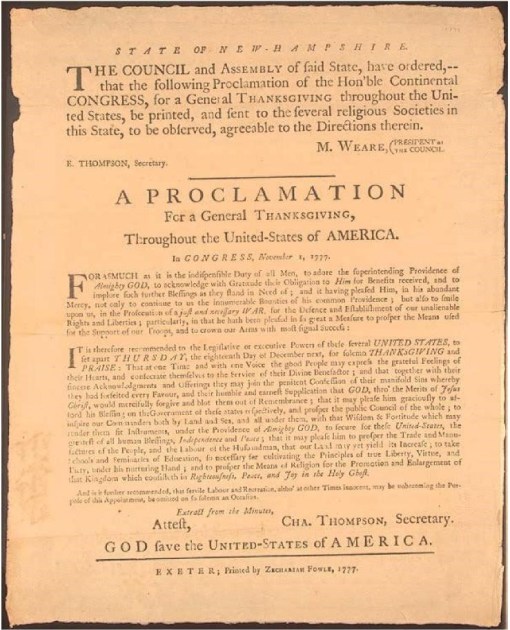
thanksgiving-proclamation  Our nation is wrapping up another Thanksgiving holiday as millions of people travel back to their homes tonight.  Most of us look forward to the fourth Thursday in November Thanksgiving and the four day weekend that surrounds it.  But, it was’t always this way.

Actually, the first Thanksgiving celebration of our new nation–the United States of America–occurred on December 18, 1777, by proclamation of the Continental Congress.

On November 1, 1777, the Continental Congress proclaimed that on December 18, 1777, the new nation would stop and give thanks to God for blessing the nation and the troops in their quest for independence and peace in the Revolutionary War.  The Thanksgiving proclamation is eloquent, and the full text follows.  I write about how General Washington and the Continental Army celebrated that first Thanksgiving in my non-fiction book, Six Days in December: General George Washington’s and the Continental Army’s Encampment on Rebel Hill, December 13 – 19, 1777, an ebook on Amazon ($2.99; soon available in print from The Elevator Group), and in my novel,  Becoming Valley Forge.   Check them out, but in the meantime, here’s the text of the Continental Congress’ Proclamation.

THE CONTINENTAL CONGRESS’ FIRST THANKSGIVING PROCLAMATION

IN CONGRESS

November 1, 1777

FORASMUCH as it is the indispensable Duty of all Men to adore the superintending Providence of Almighty God; to acknowledge with Gratitude their Obligation to him for benefits received, and to implore such farther Blessings as they stand in Need of; And it having pleased him in his abundant Mercy not only to continue to us the innumerable Bounties of his common Providence, but also to smile upon us in the Prosecution of a just and necessary War, for the Defence and Establishment of our unalienable Rights and Liberties; particularly in that he hath been pleased in so great a Measure to prosper the Means used for the Support of our Troops and to crown our Arms with most signal success:

It is therefore recommended to the legislative or executive powers of these United States, to set apart THURSDAY, the eighteenth Day of December next, for Solemn Thanksgiving and Praise; That with one Heart and one Voice the good People may express the grateful Feelings of their Hearts, and consecrate themselves to the Service of their Divine Benefactor; and that together with their sincere Acknowledgments and Offerings, they may join the penitent Confession of their manifold Sins, whereby they had forfeited every Favour, and their humble and earnest Supplication that it may please GOD, through the Merits of Jesus Christ, mercifully to forgive and blot them out of Remembrance; That it may please him graciously to afford his Blessing on the Governments of these States respectively, and prosper the public Council of the whole; to inspire our Commanders both by Land and Sea, and all under them, with that Wisdom and Fortitude which may render them fit Instruments, under the Providence of Almighty GOD, to secure for these United States the greatest of all human blessings, INDEPENDENCE and PEACE; That it may please him to prosper the Trade and Manufactures of the People and the Labour of the Husbandman, that our Land may yet yield its Increase; To take Schools and Seminaries of Education, so necessary for cultivating the Principles of true Liberty, Virtue and Piety, under his nurturing Hand, and to prosper the Means of Religion for the promotion and enlargement of that Kingdom which consisteth “in Righteousness, Peace and Joy in the Holy Ghost.”

And it is further recommended, that servile Labour, and such Recreation as, though at other Times innocent, may be unbecoming the Purpose of this Appointment, be omitted on so solemn an Occasion.

Extract from the Minutes,

Charles Thomson, Secr.

So there you have it.  A little bit of #revolutionarywarreallness.

Peace–Sheilah Vance


Take a break from election post-mortems and come to my talk at the Historical Society of Ft. Washington, Nov. 15, 7:30 p.m.

Take a break from the election post-mortems and join me on Tuesday, November 15 at 7:30 p.m. as I speak to the Historical Society of Fort WashingtonBecoming Valley Forge 9780982494592 at its headquarters, Clifton House, 473 South Bethlehem Pike, Ft. Washington, PA  19034.

General George Washington and the Continental Army were encamped at Fort Washington and Whitemarsh after the Battle of Germantown on October 4,1777 and up until they marched to Rebel Hill and Gulph Mills on December 12, 1777.  I’ll talk about all of this, including the Battle of Whitemarsh that was fought in the area  on December 5 – 8, 1777.

Of course, I’ll talk about The Philadelphia Campaign as noted in my books, Becoming Valley Forge, and Six Days in December: General George Washington’s and the Continental Army’s Encampment on Rebel Hill, December 13 – 19, 1777.

Hope to see you there.  For more information, see my page at http://www.theelevatorgroup.com.

Peace.

My talk at the Historical Society of Ft. Washington, Nov. 15, 7:30 p.m.

Please join me on Tuesday, November 15 at 7:30 p.m. as I speak to the Historical Society of Fort WashingtonBecoming Valley Forge 9780982494592 at its headquarters, Clifton House, 473 South Bethlehem Pike, Ft. Washington, PA  19034.

General George Washington and the Continental Army were encamped at Fort Washington and Whitemarsh after the Battle of Germantown on October 4,1777 and up until they marched to Rebel Hill and Gulph Mills on December 12, 1777.  I’ll talk about all of this, including the Battle of Whitemarsh that was fought in the area  on December 5 – 8, 1777.

Of course, I’ll talk about The Philadelphia Campaign as noted in my books, Becoming Valley Forge, and Six Days in December: General George Washington’s and the Continental Army’s Encampment on Rebel Hill, December 13 – 19, 1777.

Hope to see you there.  For more information, see my page at http://www.theelevatorgroup.com.

Peace.

Becoming Valley Forge — The Battle of Germantown, October 4, 1777 — Sheilah Vance

With the British marching into Philadelphia on September 23, 1777, General George Washington looked for an opportunity to attack and turn back the redcoats. Washington learned that British General William Howe had moved about 9000 redcoats to an outlying town called Germantown, which is now part of the City of Philadelphia. On this date in […]

via Becoming Valley Forge — The Battle of Germantown, October 4, 1777 — Sheilah Vance

The horror of the Paoli Massacre, 9/21/1777 & commemorating it 9/24/2016 at the site — Sheilah Vance

On this day in 1777, around midnight, British General Lord Grey and his troops performed a barbaric attack on Paoli’s General Anthony Wayne and his troops as the patriots waited in a Paoli farm hoping to ambush the British who were camped in nearby Tredyffrin. Using only their bayonets, 53 patriots were killed and over […]

via The horror of the Paoli Massacre, 9/21/1777 & commemorating it 9/24/2016 at the site — Sheilah Vance

The Philadelphia Campaign and Becoming Valley Forge Begins–The Battle of Brandywine, 9/11/1777

September 11, 1777 was the start of that period of the Revolutionary War called The Philadelphia Campaign.  That was the date of the Battle of Brandywine, the first major engagement of the patriots, numbering some 11,000, and the British redcoats, numbering some 18,000, in the Philadelphia area.  The battle took place down by the Brandywine River in the area of Chadds Ford and Kennett Square.  In late July, the British, under the command of General Sir William Howe and General Charles Cornwallis, had landed in the area at the Head of the Elk in Maryland, now called Elkton, intent on marching towards and capturing the City of Philadelphia, the capital of the new United States.  General George Washington thought that his Continental Army could stop the British, and he moved his army to the northernmost and southernmost fords–Wistar’s Ford and Pyle’s Ford–along the Brandywine.  The fords were low-lying parts of the river that would allow people to cross the river, and Washington figured that if the patriots controlled the fords from both ends, the British couldn’t cross over and head towards Philadelphia without a major hurting from the patriots.  Washington thought that he had the superior strategy and knowledge, but he soon learned that he didn’t.   The British, in a surprise manuever had taken two fords that Washington was unaware of–Trimble’s Ford on the west branch of the Brandywine River, and Jeffries Ford on the east branch of the river.  A resident of Thornbury Township, Pennsylvania, Mr. Squire Cheyney, hurriedly rode from his farm to Washington’s encampment to warn him that thousands of British troops were amassed along the Brandywine River at an unguarded ford that  was north of the ford that the patriots were guarding.  Washington also thought that the British had only a few thousand troops at Brandywine, but Cheyney warned him that the number was closer to the actual number of 18,000.  Washington quickly regrouped in enough time to avoid total disaster in the 11 hour battle.  However, the patriots suffered heavy losses–300 killed, 600 wounded, and 400 captured, compared to the British who had 93 killed, 488 wounded, and six missing.  The patriots had to retreat, leaving much equipment and ammunition on the field.  One unsung hero of the Battle of Brandywine was Ned Hector, an African-American private in Col. Proctor’s 3rd Pennsylvania Artillery Regiment.  As the British were overrunning the patriots, a call went out for the Patriots to retreat, save themselves, and leave their wagons and weapons on the battlefield. Hector refused, gathered his weapons and those that were left by his retreating colleagues before leaving the battlefield.  After the war, he resided in Conshohocken, Pennsylvania, where Hector Street is named after him.
The patriots marched towards Chester, and the British later marched up towards Easttown Township and the Valley Forge.  Other battles ensued from September 11–the Battle of the Clouds and the Battle of Paoli–until September 26, when the British marched triumphantly into Philadelphia.  I’ll write about those battles and what was going on with the people who lived in the Philadelphia area and the new nation up through the end of the encampment at Valley Forge on June 19, 1778,  as I continue this blog, Becoming Valley Forge, which is based on my novel, Becoming Valley Forge.  My novel shows how the lives of ordinary men and women who lived in the shadow of Valley Forge, Becoming Valley Forge 9780982494592
Pennsylvania, were changed forever during The Philadelphia Campaign in mid-1777, when the Revolutionary War battles came to their doorsteps, leading them and their loved ones to Valley Forge from winter 1777 through summer 1778.  Please feel free to email me at svance@theelevatorgroup.com or visit my book page by clicking here or go to http://www.TheElevatorGroup.com.   Until next time, peace!–Sheilah

For more information, see http://www.ushistory.org/brandywine/thestory.htm or click here.