Day 4, Dec. 16, 1777 — Tents arrive and British soldiers captured at Gulph Mills

Sheilah Vance's avatarSheilah Vance

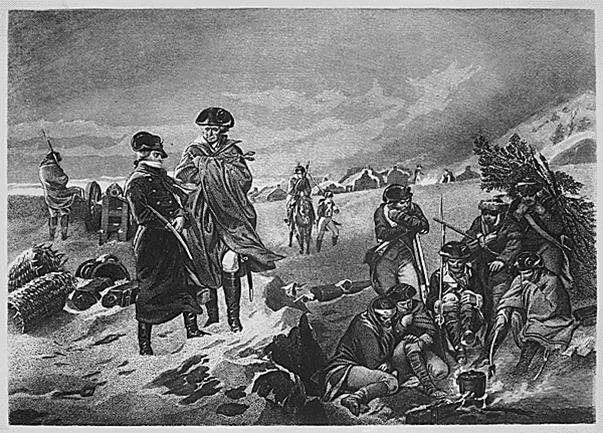
General Washington leads his soldiers through the snow (19th century engraving)

On a cold and rainy December 16, 1777, the 11,000 soldiers in George Washington’s Continental Army at Gulph Mills and Rebel Hill had one solace — tents had arrived.  They had been exposed to the snow and cold since the army arrived at the Gulph on December 12, and they had sought shelter under the rocks and trees of Rebel Hill and Gulph Mills.  Food was still scarce because a food caravan headed towards them was delayed.

Once the tents arrived, General Washington’s orders for the day were short and sweet:

“GENERAL ORDERS Head. Quarters, at the Gulph, December 16, 1777.

Parole — . Countersigns — .

The tents are to be carried to the encampment of the troops, and pitched immediately.”

The day was not just one of pitching tents and trying to find comfort for some soldiers.  Apparently, a group…

View original post 401 more words

Day 3, Dec. 15, 1777 — The Continental Army settles down at Rebel Hill and Gulph Mills

Sheilah Vance's avatarSheilah Vance

On December 15, 1777, the Continental Army has been at Gulph Mills and Rebel Hill for two days, so they are able to settle down and recoup a bit of their strength.  As Dr. Albigence Waldo, Surgeon General to the Army writes of his condition, improved as of the past two days, “Quiet. Eat Pessimmens, found myself better for their Lenient Opperation. Went to a house, poor and small, but good food within – eat too much from being so long Abstemious, thro’ want of palatables. Mankind are never truly thankfull for the Benefits of life, until they have experienc’d the want of them. The Man who has seen misery knows best how to enjoy good. He who is always at ease and has enough of the Blessings of common life is an Impotent Judge of the feelings of the unfortunate….”

Even General Washington seems to have settled down a…

View original post 1,878 more words

Day 2, Dec. 14 — Hardship plagues the Continental Army at “the Gulph”

Sheilah Vance's avatarSheilah Vance

On December 14, 1777, the condition of the 11,000 members of the Continental Army at Gulph Mills and Rebel Hill was one of extreme hardship.  The soldier’s tents were not to arrive for two more days.  There was little, if any food.

Dr. Albigence Waldo, Surgeon General to the Continental Army and a member of a Connecticut Brigade wrote, “Prisoners and Deserters are continually coming in. The Army which has been surprisingly healthy hitherto, now begins to grow sickly from the continued fatigues they have suffered this Campaign. Yet they still show a spirit of Alacrity and Contentment not to be expected from so young Troops. I am sick and discontented–out of home–poor food–hard lodging–weather cold, fatigue–nasty clothes. What sweet felicities I have left at home — a charming wife — pretty children — good cooking all agreeable — all harmonious.  Nasty Cloaths – nasty Cookery – Vomit half my…

View original post 772 more words

Day 1 — Washington’s Army at Rebel Hill


Gulph Mills

Rebel Hill and Gulph Mills

This blog post is in honor of the six days in December that General George Washington and the Continental Army spent in my home, Rebel Hill in Gulph Mills, Pa., starting on this day in 1777.  I am commemorating that by posting a blog for each of the six days.  I’ll also share a post tomorrow about my ebook, Six Days in December: General George Washington’s and the Continental Army’s Encampment on Rebel Hill, December 13 – 19, 1777, which is a prequel to my novel, Becoming Valley Forge.  Enjoy and learn…

Late in the evening of December 12, 1777, in a blinding snowstorm, George Washington and his hungry, tired, and barely-clothed army, spent from a December 11 encounter with the British at Whitemarsh, started the march from Swedes Ford, in Norristown, to Gulph Mills. One soldier writes, “We are ordered to march over the river. It snows–I’m sick–eat nothing–no whiskey–no baggage–Lord-Lord-Lord–. Till sunrise crossing the river cold and uncomfortable.”

At 3 a.m. on December 13, 1777, George Washington and his army marched into Gulph Mills, where Rebel Hill is located. ”…at 3 a.m. encamped near the Gulph where we remained without tents or blankets in the midst of a severe snow storm.”

Several historians believe that Washington was going to make Gulph Mills the Continental Army’s winter headquarters because if he had decided on Valley Forge, it would have been easier to march his tired army straight to Valley Forge, rather than detour them several miles to Gulph Mills. Some of the letters from members of the army bear that out Soldier Timothy Pickering wrote, “the great difficulty is to fix a proper station for winter quarters. Nothing else prevents our going into them…it is a point not absolutely determined.”

Because of their elevation, Rebel Hill and the hills of Gulph Mills provided an advantageous view for miles around. The army could have easily seen the British advancing from Philadelphia to the east, where the British established winter headquarters. Also, Rebel Hill gave the army great access to the Schuylkill River, particularly the crossing points of Matson’s Ford and Swede’s Ford. Finally, Rebel Hill was friendly territory–it got its name because the people who lived there were definitely rebels and patriots supporting the Continental Army.

In any event, General Washington had to get his army, which had no tents to shield them from the elements, settled. He issued these orders:

GENERAL ORDERS December 13, 1777.

Head-Quarters, at the Gulph,

Parole Carlisle. Countersigns Potsgrove, White Marsh.

The officers are without delay to examine the arms and accoutrements of their men, and see that they are put in good order.

Provisions are to be drawn, and cooked for to morrow and next day. A gill of Whiskey is to be issued immediately to each officer, soldier, and waggoner.

The weather being likely to be fair, the tents are not to be pitched. But the axes in the waggons are to be sent for, without delay, that the men may make fires and hut themselves for the ensuing night in the most comfortable manner.

The army is to be ready to march precisely at four o’clock to morrow morning.

An officer from each regiment is to be sent forthwith to the encampment on the other side Schuylkill, to search that and the houses for all stragglers, and bring them up to their corps. All the waggons not yet over are also to be sent for and got over as soon as possible.

Mr. Archibald Read is appointed paymaster to the 8th. Pennsylvania regiment, and is to be respected as such.

On to Day 2…


Threshold to the Rebel Hill Encampment 12/13 – 19, 1777: The Battle of Matson’s Ford, 12/11/1777

James Potter

Growing up near Matson’s Ford Road and living on Rebel Hill in Upper Merion Township, I never leaarned about the Battle  of Matson’s Ford in school, but I should have.  It’s an important prelude to General George Washington and the Continental Army’s march to Valley Forge.  I wrote about the Battle of Matson Ford in my ebook, Six Days in December: General George Washington and the Continental Army’s Encampment on Rebel Hill, December 13 – 19, 1777.  Please see the excerpt below:

“On December 11, Washington’s Army began marching to the Rebel Hill area for what some historians thought would be the army’s winter quarters. However, on that day, the army was not aware that British General Cornwallis had 3000 troops brutally foraging through Rebel Hill and Gulph Mills , taking whatever food and provisions they could find from local residents. The first divisons of Washington’s Army began crossing over from Whitemarsh over a bridge they had constructed at Matson’s Ford. As they came over, they saw

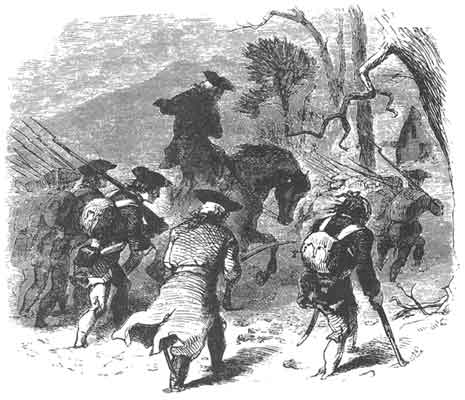
Cornwallis’ troops up on Rebel Hill and on Prospect Hill, on the other side of what is now Matson’s Ford Road. General James Potter [pictured here], with part of the Pennsylvania Militia, had been at Harriton Plantation on Old Gulph Road. His regiments began attacking the British, and his men formed battle lines on Rebel Hill and other hills in Gulph Mills over four miles. Gen. Potter’s men fought bravely until the sheer numbers of British soldiers caused them to retreat back across the bridge at Matson’s Ford, as had other tropps that had crossed over, where the rest of Washington’s Army was waiting. Gen. Washington lauded Gen. Potter and the Pennsylvania militia in his Orderly Book of December 12, 1777, writing, “The Commander-in-Chief, with great pleasure, expresses his approbation of the behavior of the Pennsylvania Militia yesterday, under General Potter, on the vigorous opposition they made ot a body of the enemy on the other side of the Schuylkill.” However, General Potter later lamented the retreat because it left the residents of Rebel Hill and Gulph Mills to the British plundering. In a report to Thomas Wharton, President of the Supreme Executive Council of Pennsylvania, Potter wrote, “…thus the enemy Got leave to plunder the Countrey, which they have dun without parsiality or favour to any, leaving none of the Nessecereys of life Behind them that the conveniently could Carry or destroy….”4

There are several versions of how Rebel Hill got its name. One is that British General Cornwallis, who led the 3000 British soldiers in the foraging raid on December 11, called it Rebel Hill because the British Army found that the hill was full of rebels—or what we call patriots. Another is that it was called Rebel Hill because Continental Army General William Alexander “ Lord Stirling” commanded an outpost on the hill during the Valley Forge encampment. While on Rebel Hill, General Lord Stirling stayed at the home of Jonathan Rees. Joining General Stirling on Rebel Hill was his aide-de-camp, James Monroe, who later went on to become the 5th President of the United States.

No matter how Rebel Hill got its name, it has a proud history in the founding of this nation. As one historian noted, “These grounds were the threshold to Valley Forge, and the story of that winter—a story of endurance, forebearance, and patriotism which will never grow old—had its beginnings here, at the six days encampment by the old Gulph Mill.”

Who knew, right?  Of course, I write about this battle in my new book, Becoming Valley Forge.

For more about the Battle of Matson’s Ford, see: an interactive presentation by Kelsey Doucetthe Universal EncyclopediaWikipedia, and others.

Peace!

Sheilah Vance

Pre-order Becoming Valley Forge now

BVF-web

Becoming Valley Forge, a novel by Sheilah Vance, can now be pre-ordered at The Elevator Group website for only $15.00 (normally $17.95) and reduced shipping of $3.  Please click here to order.  For more information about the novel, click here.

Or, if you feel more comfortable ordering at Amazon, click here.

Enjoy!


Happy Thanksgiving!

Gulph MillsHappy Thanksgiving to everyone! As we all enjoy our time with family and friends, did you know that the first Thanksgiving that was celebrated as this new nation called the United States was celebrated on December 18, 1777 by order of the Continental Congress? And, on that day, General George Washington and 10,000 soldiers in the Continental Army celebrated Thanksgiving while they were encamped on my home ground, Rebel Hill and Gulph Mills in Pennsylvania. You can read more about that in my book, Six Days in December: General George Washington’s and the Continental Army’s Encampment on Rebel Hill–December 13 – 19, 1777, and my new novel, Becoming Valley Forge. Read about and buy both on my author page on Amazon or my website, http://www.theelevatorgroup.com. Have a great day! Peace.

Day 1, Dec. 13, 1777 — Washington’s Army at Rebel Hill

Rebel Hill and Gulph Mills

Late in the evening of December 12, 1777, in a blinding snowstorm, George Washington and his hungry, tired, and barely-clothed army, spent from a December 11 encounter with the British at Whitemarsh, started the march from Swedes Ford, in Norristown, to Gulph Mills.  One soldier writes, “We are ordered to march over the river.  It snows–I’m sick–eat nothing–no whiskey–no baggage–Lord-Lord-Lord–.  Till sunrise crossing the river cold and uncomfortable.”

At 3 a.m. on December 13, 1777, George Washington and his army marched into Gulph Mills, where Rebel Hill is located.  “…at 3 a.m. encamped near the Gulph where we remained without tents or blankets in the midst of a severe snow storm.”

Several historians believe that Washington was going to make Gulph Mills the Continental Army’s winter headquarters because if he had decided on Valley Forge, it would have been easier to march his tired army straight to Valley Forge, rather than detour them several miles to Gulph Mills.  Some of the letters from members of the army bear that out  Soldier Timothy Pickering wrote, “the great difficulty is to fix a proper station for winter quarters. Nothing else prevents our going into them…it is a point not absolutely determined.”

Because of their elevation, Rebel Hill and the hills of Gulph Mills provided an advantageous view for miles around.  The army could have easily seen the British advancing from Philadelphia to the east, where the British established winter headquarters.  Also, Rebel Hill gave the army great access to the Schuylkill River, particularly the crossing points of Matson’s Ford and Swede’s Ford.  Finally, Rebel Hill was friendly territory–it got its name because the people who lived there were definitely rebels and patriots supporting the Continental Army.

In any event, General Washington had to get his army, which had no tents to shield them from the elements, settled.  He issued these orders:

GENERAL ORDERS December 13, 1777.

Head-Quarters, at the Gulph,

Parole Carlisle. Countersigns Potsgrove, White Marsh.

The officers are without delay to examine the arms and accoutrements of their men, and see that they are put in good order.

Provisions are to be drawn, and cooked for to morrow and next day. A gill of Whiskey is to be issued immediately to each officer, soldier, and waggoner.

The weather being likely to be fair, the tents are not to be pitched. But the axes in the waggons are to be sent for, without delay, that the men may make fires and hut themselves for the ensuing night in the most comfortable manner.

The army is to be ready to march precisely at four o’clock to morrow morning.

An officer from each regiment is to be sent forthwith to the encampment on the other side Schuylkill, to search that and the houses for all stragglers, and bring them up to their corps. All the waggons not yet over are also to be sent for and got over as soon as possible.

Mr. Archibald Read is appointed paymaster to the 8th. Pennsylvania regiment, and is to be respected as such.

On to Day 2…