Shared Post Honoring my fictional women in Women’s History Month

Sheilah Vance posted: “As a novelist, I have created many remarkable female characters who have given my novels heart, soul, excitement, suspense, sass, heartache, and every other emotion imaginable. These women come to me as voices in my head, tugging at my heart, upsetting m”

Sheilah Vance (svance@theelevatorgroup.com) shared a post from Sheilah Vance

Honoring my fictional women in Women’s History Month

by Sheilah Vance

As a novelist, I have created many remarkable female characters who have given my novels heart, soul, excitement, suspense, sass, heartache, and every other emotion imaginable. These women come to me as voices in my head, tugging at my heart, upsetting my stomach, begging for their stories to be told. They helped me build “my empire”, …

Read more of this post

Sheilah Vance | March 28, 2016 at 10:00 am | Categories: Uncategorized | URL: http://wp.me/p20zol-4u

Comment See all comments
Change your email settings at Manage Notifications.

Trouble clicking? Copy and paste this URL into your browser:
http://sheilahvance.com/2016/03/28/honoring-my-fictional-women-in-womens-history-month/

Thanks for flying with WordPress.com

Elevator Group author featured on Valley Forge Park’s video on Patriots of African Descent in the Revolutionary War

Elevator Group author Dr. Marion Lane is an expert in the history of African American’s involvement in the Revolutionary War.  She’s featured on this  video clip    from the Valley Forge National Park talking about Patriots of African Descent in the Revolutionary War.

Read more about her children’s book Patriots of African Descent in the Revolutionary War.

Congratulations Marion!

Calling all cattle! 2/18/78


The first few weeks of February were hard ones for the Continental Army.  After almost two months at Valley Forge, food was very scarce.  General George Washington called upon the patriotism of supporters of liberty in five Eastern states — New Jersey, Pennsylvania, Delaware, Maryland and Virginia–to fatten up their cattle, get them to Valley Forge, and sell them to the Continental Army.

Proclamation on Cattle, 18 February 1778

Proclamation on Cattle

Head Quarters Valley Forge February 18th 1778

To the Inhabitants of New Jersey, Pensylvania, Delaware, Maryland & Virginia.

Friends, Countrymen and Fellow Citizens! After three Campaigns, during which, the brave Subjects of these States have contended, not unsuccessfully, with one of the most powerful Kingdoms upon Earth, we now find ourselves, at least, upon a level with our opponents; and there is the best reason to believe, that efforts, adequate to the abilities of this Country, would enable us speedily to conclude the war, and to secure the invaluable blessings of Peace, Liberty and safety. With this view, it is in contemplation, at the opening of the next Campaign, to assemble a force sufficient, not barely to cover the Country from a repetition of those depredations, which it hath already suffered, but also to operate offensively, and strike some decisive blow.

In the prosecution of this object, it is to be feared, that so large an Army may suffer for the want of Provisions. The distance, between this and the Eastern States, from whence considerable supplies of Flesh have been hitherto drawn, will necessarily render those supplies extremely precarious. And unless the virtuous yeomanry of the States of New Jersey, Pensylvania, Delaware, Maryland and Virginia will exert themselves to prepare Cattle, for the use of the Army, during the Months of May, June and July next, great difficulties may arise in the course of the Campaign. It is therefore recommended to the Inhabitants of those States, to put up and feed, immediately, as many of their Stock Cattle, as they can spare, so as that they may be driven to this Army, within that Period. A bountiful price will be given, and the Proprietors may assure themselves, that they will render a most essential service to the illustrious cause of their Country, and contribute in a great degree to shorten this bloody contest. But should there be any, so insensible to the common interest, as not to exert themselves, upon these generous principles; the private interest of those, whose situation makes them liable to become immediate subjects to the Enemies incursions, should prompt them, at least to a measure, which is calculated to save their property from plunder, their families from insult, and their persons from abuse, hopeless confinement—or perhaps a violent death.


Source –“Proclamation on Cattle, 18 February 1778,” Founders Online, National Archives (http://founders.archives.gov/documents/Washington/03-13-02-0489 [last update: 2015-12-30]). Source: The Papers of George Washington, Revolutionary War Series, vol. 13, 26 December 1777 – 28 February 1778, ed. Edward G. Lengel. Charlottesville: University of Virginia Press, 2003, pp. 577–578.


Here’s what happens when the war comes to your back yard

IndexImagine having to deal with the cold that we’ve been having and live in a  wooden hut with only fire for heat, practically starving, too.  That was the state of affairs at Valley Forge, just about two months in to the Continental Army’s encampment.  So where was the army supposed get its food? From the farmers who lived in the area.  The theme of my novel, Becoming Valley Forge, is what happens when the war comes to your back yard? How did the people in the Philadelphia area fare during the Valley Forge encampment and that period from September 11, 1777 through the Valley Forge march out that’s called The Phialdlephia campaign?

Here’s a letter from General George Washington to General Anthony Wayne, who lived with his men at Valley Forge, even though his home was a few miles away in Paoli.  Washington is directing Wayne to lead a foraging expedition to gather up food, cattle, sheep, and just about anyting else that you can eat for the use of the Continental Army.  Washington tells Wayne that if his men can’t arrange to take the food out of some areas, like the islands between Philadelphia and Chester, they should burn it so the British, who were occupying Philadlephia, can’t come out and get it on a foraging party of their own.

What happens when the war comes to your back yard? Here’s what:

From George Washington to Brigadier General Anthony Wayne, 9–12 February 1778

To Brigadier General Anthony Wayne

Head Quarters Valley Forge

9[–12]th Feby 1778Sir

The good People of the State of Pennsa Living in the Vicinity of Philadelphia and near the Delaware River—having suffered much by the Enemy Carrying off their Property without allowing them any Compensation—thereby Destressing the Inhabitants—Supplying their own Army and Enabling them to protract the Cruel and unjust War that they are now Wageing against these States.

And Whereas by Recent Intelligence I have reason to expect that they Intend making an Other grand forage into this Country—It is of the utmost Consequence—that the Horses Cattle Sheep and Provender (Within fifteen miles West from the River Delaware between the Schuylkill and the Brandywine) be Immediately removed to prevent the Enemy from Receving any benefit therefrom, as well as to Supply the present exegencies of the American Army.

I do therefore Authorise, Impower, and Command you forthwith, to take, carry off, and Secure, all such Horses as are Suitable for Cavalry, or for Draft, all Cattle and Sheep fit for Slaugter, together with every kind of forage, for the use of this Army—that may be found in the possession of any of the Inhabitants within the aforesaid Limits causing Certificates to be given to each person for the Number, Value and Quantity of the Horses, Cattle, Sheep & Provender so taken1—Notice will be given to the holders of such Certificates by the Commissary and Qr Master Genl when and where they may apply for Payment that they may not be disappointed in calling for the money.

All Officers Civil and Military—Commissaries Quarter Masters &ca are hereby Ordered to obey aid & Assist you in this necessary buisness.

All the provender on the Islands between Phila. and Chester, which may be Difficult of Access or too Hazardous to attempt Carrying off—you will Immediately cause to be Destroyed giving Derections to the Officer or Officers to whom this duty is Assigned to take an Acct of the Quantity—together with the Owners names, as far as the Nature of the Service will admit.2 Given at Head Quarters Valley Forge 12th Feby 1778.

G.W

(cited from  “From George Washington to Brigadier General Anthony Wayne, 9–12 February 1778,” Founders Online, National Archives (http://founders.archives.gov/documents/Washington/03-13-02-0411 [last update: 2015-12-30]). Source: The Papers of George Washington, Revolutionary War Series, vol. 13, 26 December 1777 – 28 February 1778, ed. Edward G. Lengel. Charlottesville: University of Virginia Press, 2003, pp. 492–493.)

So, what would you have done when General Wayne and his men showed up at your door?

More to come.

Peace–SV


Feb. 22, 1778 — Washington’s Birthday

So how did General George Washington spend his birthday on February 22, 1778 when he was encamped at Valley Forge? His wife, Martha, had arrived in camp on February 10 and stayed with him until the army marched out in June.  It’s reported that she arranged a quiet birthday dinner for him, even though the army was experiencing a great food shortage.  (click here for more citation and more information). She had her cooks prepare a special birthday cake, making its serving the first public celebration of Washington’s Birthday.  A cake using Martha’s recipe is still served on Washington’s Birthday at Valley Forge National Park.

Martha Washington

Martha Washington

Pleasant celebration aside, Washington spent a great deal of time that day also meting out necessary discipline to some of the 11,000 soldiers who were encamped with him.  Just like any army, commanders must court martial soldiers who get out of line.  It was no different in the Continental Army.  On February 22, Washington’s general orders were largely focused on confirming the discipline that was meted out in court martial hearings, setting the stage for such discipline to occur.  It would be considered barbaric today, but most of the discipline confirmed that day was 100 lashes to the bare back “well laid on.”

Here’s Washington’s General Orders for the day, with the court martial information italicized:

Head-Quarters Valley-Forge Feby 22nd 1778—Sunday.

Parole: Orkney—Countersign: Ormond—Otway—

The Commissary General is, if possible to keep the Camp well supplied with rice for the use of the sick; if rice cannot be had, Indian meal is to be provided in it’s place; and as this is an article that can at all  times and under all circumstances be had no excuse will be admitted for the neglect.

He is every monday to make a return of all his issues in the course of the week and of his stock on hand in Camp, and on the first day of every month the issues in the month preceeding are to be carefully made out and forwarded to the Commissary General who is to return the whole in one view as soon after as possible to The Commander in Chief—A Monthly Return is also to be made of the quantity of provisions and other articles in the Commissary’s department.

The regimental Surgeons are desired to be more punctual in making returns of their sick to the Chief Surgeon of the flying Hospital present on every Monday.

At a General Court Martial whereof Colonel Cortlandt was President (Feby 17th 1778) Thomas Scott of 5th Pennsylvania Regiment tried for desertion and unanimously acquitted: Likewise Thomas Lawler of 4th Pennsylvania Regt tried for deserting to the Enemy the 5th of October last, found guilty and sentenced to receive one hundred lashes on his bare back well laid on—Also James Low of 13th Pennsylvania Regiment tried for the same Crime found guilty & sentenced to receive one hundred lashes on his bare back—Also John Henry of 7th Pennsylvania Regiment tried for the same crime & acquitted.

Likewise Thomas Whitney of Coll Bowman’s Company of Artillery1 tried for the same crime found guilty and sentenced to receive one hundred lashes on his bare back well laid on.

At the same Court William Harris of 9th Pennsylvania Regiment tried for getting drunk, threatning the life of one Cameron and knocking him down, also for striking the Corporal of the quarter Guard after being confined, and Dennis Kennedy of 9th Pennsylvania Regt tried for striking and abusing said Cameron and threatning to desert as soon as he got shoes & cursing Congress; William Harris found guilty of striking the Corporal of the Guard, being a breach of Article 5th section 18th of the Articles of War and sentenced to receive thirty lashes on his bare back—Dennis Kennedy found guilty also of the charge alledged against him and sentenced to receive one hundred lashes on his bare back.

The Commander in Chief approves the aforegoing sentences and orders those against Lawler Low, Whitney, Harris and Kennedy to be put in execution tomorrow morning at roll-call at the heads of the regiments to which they respectively belong.

Scott to be immediately released from his confinement also Henry who is to join his regiment.

Source:  General Orders, 22 February 1778,” Founders Online, National Archives (http://founders.archives.gov/documents/Washington/03-13-02-0542 [last update: 2015-12-30]). Source: The Papers of George Washington, Revolutionary War Series, vol. 13, 26 December 1777 – 28 February 1778, ed. Edward G. Lengel. Charlottesville: University of Virginia Press, 2003, pp. 637–639.


2/16/78 — Washington’s troops about to mutiny

In my last post, I wrote about how the Continental Army was faring during its first month at Valley Forge.  Well, after about two months, the situation continues to go downhill.  Here, General George Washington writes to Brigadier General William Smallwood that the troops are so hungry and cold that they’re about to mutiny.  He directs Smallwood to go to Dover, Delaware and Head of the Elk, Maryland to help Captain Lee and his soldiers take some food from the storehouses (called magazines) there and bring it back to Valley Forge.

Index

From George Washington to Brigadier General William Smallwood, 16 February 1778

To Brigadier General William Smallwood

Hd Qrs Valley Forge Feby 16 1778

Dr sr

The distress of this army for want of provisions is perhaps beyond any thing you can conceive; and unless we strain every nerve to procure immediate relief, a general mutiny and dispersion is to be dreaded. Our nearest Magazines are at Dover and the Hd of Elk; and it is absolutely necessary, by a vigorous effort, to push on all the provisions at those places, for the present subsistence of the Troops. I have intrusted this important business to the zealous activity of Capt. Lee, whom I haveimpowerd to impress the number of Waggons requisite for the purpose.1 He will probably stand in need of some assistants, acquainted with the neighbouring Country, to facilitate & dispatch the business. I imagine you can furnish him with proper persons for the purpose, Officers in the Maryland & Delaware Troops. Every aid you can possibly afford him is demanded by the exigency of the occasion. I am Dr sr Yrs &c.

G. W——n

P.s. I do not know in what manner, the troops under your Command have been hitherto supplied with provisions, but as you are in an abundant Country, I should imagine you might furnish yourself from the resources of it, without the help of the magazines above mentioned, no part of which can, without detriment, be spared from the use of this Camp.

Source:  “From George Washington to Brigadier General William Smallwood, 16 February 1778,” Founders Online, National Archives (http://founders.archives.gov/documents/Washington/03-13-02-0478 [last update: 2015-12-30]). Source: The Papers of George Washington, Revolutionary War Series, vol. 13, 26 December 1777 – 28 February 1778, ed. Edward G. Lengel. Charlottesville: University of Virginia Press, 2003, pp. 563–564.

The Army’s First Month at Valley Forge

As we grapple with two and three feet of snow and freezing temperatures, imagine what it was like for the soldiers at Valley Forge when large amounts of snow fell on and around their wood huts, heated only by the fireplaces inside.  While most of us had a great holiday season with wonderful Christmas, Hannakuh, Kwanzaa and other celebrations, surrounded by family and friends, imagine what the past month was like for the General George Washington and the Continental Army at Valley Forge.  Since the Continental Army marched into Valley Forge on December 19, the following are among some of the things that have happened:
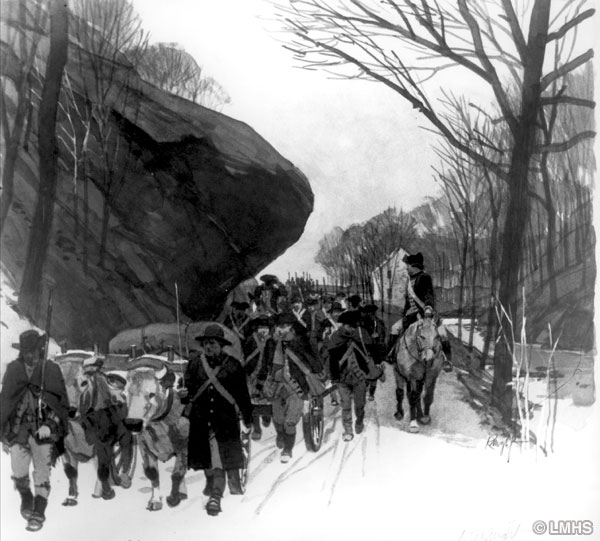
  • The soldiers built huts in accordance with General Washington’s very specific orders.
  • General Washington wrote Congress after only a few days at Valley forge that “if some great and capital change does not take place, the army will starve, dissolve or disperse.”
  • The great author Thomas Paine, whose “Common Sense” convinced a great many people that independence from England was necessary, visited Valley Forge.  He wrote Ben Franklin that all of the soldiers were busy building huts.
  • The residents of the area who just had some 11,000 soldiers come to their back yards received an order from General Washington that they donate half of their grain to the Continental Army–this would be half of what was left after the British, who had been around the area for months, stole whatever they could get their hands on.
  • A group of women from Philadelphia drove up ten teams of ox and delivered 2,000 shirts.
  • General Washington declared some 4,000 men unfit for duty because they didn’t have clothes and supplies.
  • General Lighthorse Harry Lee and his men successfully defended his outpost at Signal Hill (now A Child’s Place day care center on Sugartown Road in Devon, right on the grounds where I used to live) from a group of British marauders.
  • A sutler, or a civilian merchant, was appointed to each regiment to sell liquor.

So, as we dig out from the Blizzard of 2016 and go back inside our comfortable heated homes to rest, imagine the sacrifice that was being made at Valley Forge 238 years ago.

You can read more about it in my novel, Becoming Valley Forge.

Stay safe and warm.

Peace.

Day 7, Dec. 19, 1777 — Washington’s Army marches out of Rebel Hill and Gulph Mills and on to Valley Forge

Sheilah Vance's avatarSheilah Vance

On December 19, 1777, at 10 a.m., George Washington and his Continental Army marched out of Rebel Hill and Gulph Mills, past the Hanging Rock, and on to Valley Forge.  As one historian wrote, “These grounds were the threshold to Valley Forge, and the story of that winter–a story of endurance, forbearance, and patriotism which will never grow old–had its beginnings here, at the six days encampment by the old Gulph Mill.” (see  “The Gulph Hills in the Annals of the Revolution”, by Samuel Gordon Smyth, of West Conshohocken, in an address before the Montgomery County Historical Society, at Ashbourne, Pa., October 6, 1900; address included in Historical Sketches of Montgomery County, Volume 3, Montgomery County Historical Society (1905)).

Captured in the writings of the time and iconic paintings, we know that the March to Valley Foge was largely characterized by hardship for Washington’s 11,000 soldiers. William Trego, painter of…

View original post 2,295 more words

Day 6, Dec. 18, 1777 — George Washington’s Army celebrates the new nation’s first Thanksgiving at Rebel Hill and Gulph Mills and prepares to set up camp at Valley Forge

Sheilah Vance's avatarSheilah Vance

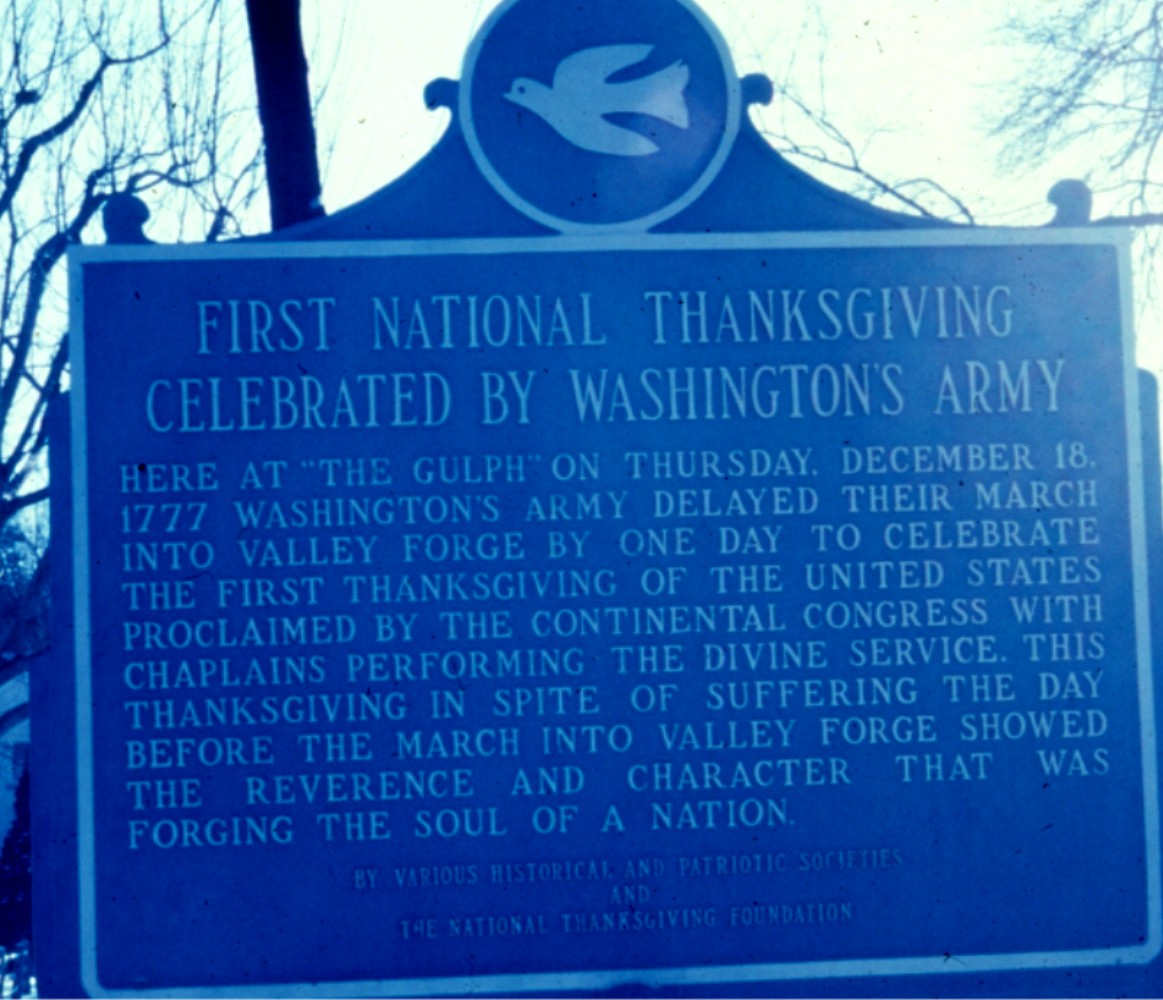
On December 18, 1777, General George Washington’s army celebrated the first national Thanksgiving in Gulph Mills and on Rebel Hill.  The celebration caused a one day delay in the army’s march to Valley Forge, which General Washington had decided a day earlier, was to be where the army would make its winter quarters.

The purpose of the Thanksgiving, according to the November 1, 1777 proclamation of the Continental Congress, was for “Solemn Thanksgiving and Praise” and  “to inspire our Commanders both by Land and Sea, and all under them, with that Wisdom and Fortitude which may render them fit Instruments, under the Providence of Almighty GOD, to secure for these United States the greatest of all human blessings, INDEPENDENCE and PEACE…”

Reverend Israel Evans, chaplin to General Poor’s New Hampshire brigade, preached at least one of the Thanksgiving sermons.  The text of his sermon was printed by Lancaster, Pa. printer…

View original post 1,575 more words

Day 5, Dec. 17, 1777 — Gen. Washington issues inspirational orders announcing the move to Valley Forge and prepares for nation’s first Thanksgiving celebration on Rebel Hill and Gulph Mills

Sheilah Vance's avatarSheilah Vance

Generals George Washington, Marquis de Lafayette, and Nathaniel Green (Gilder Lehrman collection)

December 17, 1777 was a momentous day on Rebel Hill and Gulph Mills.

After weeks of debate, General Washington decided on Valley Forge as the site of the Continental Army’s winter quarters.  As hard as it is for us to believe today, armies at this time generally did not fight in the winter.  It was extremely difficult for all of the people and objects of war to move.  Armies went into winter quarters and prepared for the resumption of conflict in the spring.

Nothing that I could write about General Washington’s decision is more eloquent and moving than his General Orders for that day, which appear below in full text.

In those Orders, Washington mentions that the march to winter quarters will be delayed for a day so the Continental Army can celebrate the new nation’s first Thanksgiving.  The…

View original post 1,042 more words